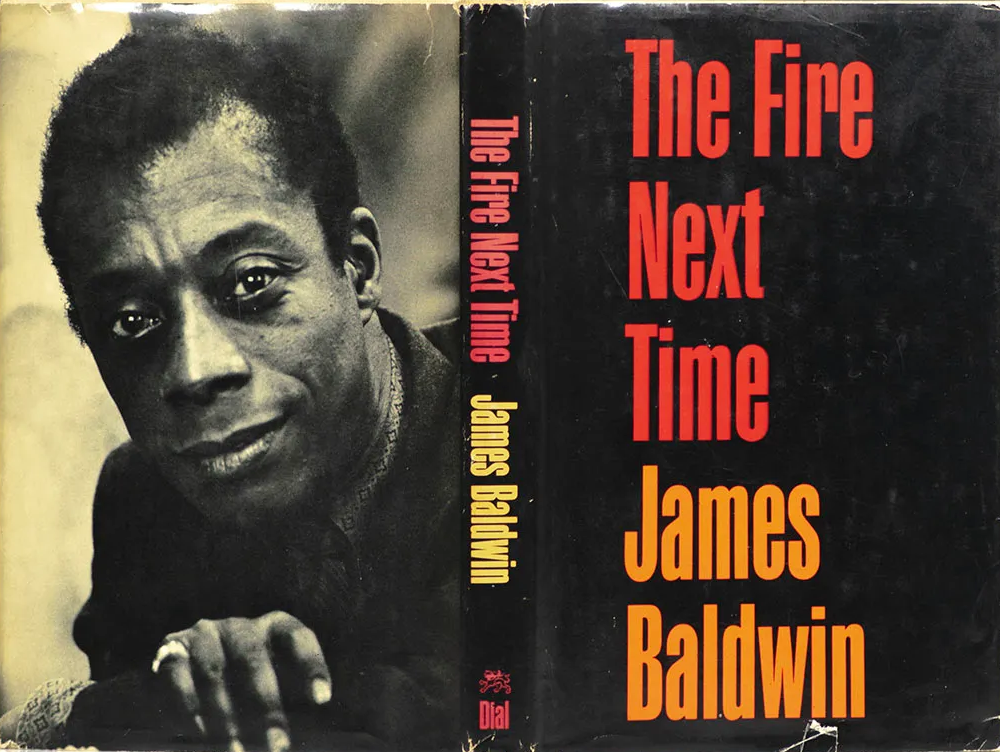
In the essays of The Fire Next Time, James Baldwin's prose is so full of passion, you can glimpse the blood and muscle concealed just beneath it. In "Down at the Cross: Letter from a Region in My Mind," Baldwin writes that as a young man in Harlem he was searching for an escape from his circumstances. “Every Negro boy—in my situation during those years, at least—who reaches this point realizes, at once, profoundly, because he wants to live, that he stands in great peril and must find, with speed, a ‘thing,’ a gimmick, to lift him out, to start him on his way. And it does not matter what that gimmick is.”
He tries different gimmicks. He embraces Christianity and becomes a youth preacher, only to become disillusioned by the hypocrisies of the church. He listens with interest to the teachings of the Nation of Islam, and he recounts a remarkable meeting he had with their leader Elijah Muhammad—but he cannot ultimately endorse his racial absolutism either. (“I knew two or three people, white, whom I would trust with my life,” Baldwin writes, “and I knew a few others, white, who were struggling as hard as they knew how, and with great effort and sweat and risk, to make the world more human. But how could I say this?”) He does not sugarcoat the malice that African-Americans face daily in this country: “In a society that is entirely hostile, and, by its nature, seems determined to cut you down—that has cut down so many in the past and cuts down so many every day—it begins to be almost impossible to distinguish a real from a fancied injury.”
This short book is a searing and unsparing indictment of America’s treatment of African-Americans, while voicing a muted hope for a future that might be different. “America, of all the Western nations, has been best placed to prove the uselessness and the obsolescence of color. But it has not dared to accept this opportunity, or even to conceive of it as an opportunity.”
—Charles Wilson