Victor Frankl lost his father, mother, brother, and his wife in Nazi Germany’s concentration camps. He spent three years himself in Auschwitz, Dachau and other camps, before improbably being liberated when the war ended. (“The odds of surviving the camp were no more than one in twenty-eight,” he wrote, “as can easily be verified by exact statistics.”)
He went on to make good use of the extra time afforded him. He published 27 books and conceived his own school of psychiatry called “logotherapy,” which sought to help people find purpose in their lives. (“Logos” is the Greek word for “meaning.”) In his therapy sessions, Frankl would ask his patients: “Why do you not commit suicide?” The answers, he believed, revealed what still kept his patients tethered to this world—and what could serve as the building blocks of their rehabilitation. Frankl’s empathy for others was no doubt informed by heartbreak. His writing, another prominent 20th-century psychologist wrote, has “a profoundly honest ring,” because it rests “on experiences too deep for deception.”
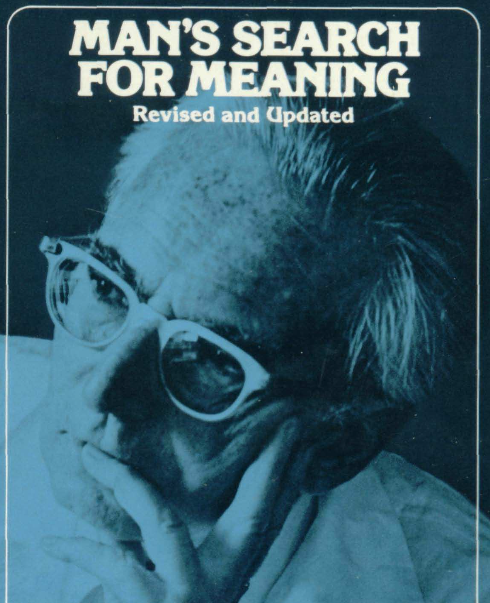
The most famous of Frankl’s books is Man’s Search for Meaning. In explaining the book’s success, Frankl would later give credit to its title, claiming that “if hundreds of thousands of people reach out for a book whose very title promises to deal with the question of a meaning to life, it must be a question that burns under their fingernails.”
The book’s enduring appeal, though, has little to do with its title alone. It describes the author’s harrowing experience in the Nazi death camps, where “every circumstance conspires to make the prisoner lose his hold.” Frankl writes in moving detail of his mental processes as life strips him (like Job, of the Bible) of everything important to him.
When Frankl’s train enters Auschwitz, he describes a cascade of emotions. His own study of psychology had made him recognize that men and women encountering the prospect of death can cling to a “delusion of reprieve,” a false hope for a miraculous rescue. Yet when that reprieve does not come—when some on his train were sent directly to the gas chambers, and those lucky enough to survive that fate were nonetheless stripped of their possessions and dignity—Frankl says a new recognition emerged, the awareness “that we had nothing to lose except our ridiculously naked lives.”
Frankl admits that while the thought of suicide was entertained by nearly everyone at Auschwitz, he made himself “a firm promise, on my first evening in camp, that I would not ‘run into the wire,’” referring to the method of hurling one’s self against the electrically charged barbed-wire fence. To him and many of his fellow prisoners, apathy became a defense against feeling too much. To witness suffering, “the dying and the dead, became such commonplace sights to him after a few weeks of camp life that they could not move him any more.”
Despite the horrors that surrounded him, though, Frankl is shaken out of this impassivity by demonstrations of human kindness. He catches glimpses of humanity even in his captors. He says that it was “apparent that the mere knowledge that a man was either a camp guard or a prisoner tells us almost nothing. Human kindness can be found in all groups, even those which as a whole it would be easy to condemn.” He remembers that even among the guards, some took pity upon the prisoners. One foreman, he remembers, “secretly gave me a piece of bread which I knew he must have saved from his breakfast ration. It was far more than the small piece of bread which moved me to tears at that time. It was the human ‘something’ which this man also gave to me—the word and look which accompanied the gift.”
Frankl began to see “that apathy could be overcome, irritability suppressed,” and it led him to believe that “man can preserve a vestige of spiritual freedom, of indepdence of mind, even in such terrible conditions of psychic and physical stress.” If there “is a purpose to life at all,” he writes, “there must be purpose in suffering and in dying. But no man can tell another what this purpose is. Each must find out for himself, and must accept the responsibility that his answer prescribes.”
Much of philosophy and religion has grappled with a central question of why there is needless suffering. But Frankl flips that question on its head. Instead of running away from the question of suffering—or attempting to rationalize it—Frankl takes a radical position: life’s meaning can reside in the suffering itself. And even in the most powerless of situations, he found “there were always choices to make,” he writes. “Every day, every hour, offered the opportunity to make a decision, a decision which determined whether you would or would not submit to those powers which threatened to rob you of your very self, your inner freedom.” He eventually comes to a remarkable conclusion. With “all the familiar goals in life are snatched away,” he writes, there still remained “the last of human freedoms”: the ability to “choose one’s attitude in a given set of circumstances.”
I thought recently of Frankl when considering the life of the civil rights hero John Lewis, who was trained in nonviolent protest, and who risked his life multiple times by marching bravely over the bridge at Selma to fight for voting rights, or by participating in the “freedom rides” that sought to dismantle segregation in interstate public transportation. One of Lewis’s favorite poems was “Invictus,” and its ending captures a reality that Lewis and Frankl embodied: “I am the master of my fate,/I am the captain of my soul.”
—Charles Wilson